"AI vocal plugin" has become one of the most searched phrases in music production, and it covers very different tools. Some change who a voice sounds like, some split a song into stems, some find the key or line up doubles for you, and a new kind lets you mix a vocal by simply asking for the sound you want. This guide sorts out what each type actually does, what to expect from it in a real session, and how to choose the one that solves your problem.
What people mean by an AI vocal plugin
The word "AI" is used loosely in audio. In practice, the tools sold under that label fall into five families:
-
Voice changers and voice models: they turn one voice into another timbre, often trained on recordings of a target voice. They are creative tools with real legal and ethical limits when the target is a real person.
-
Stem separation: they pull vocals, drums and bass out of a finished mix. Useful for remixes, practice and sampling, not for processing your own recorded voice.
-
Detection tools: they listen to the audio and make a decision for you, such as the key of the song, where the words start, or which frequencies are too harsh. Many of them were called "smart" long before the word AI became popular.
-
Assistant-style mixing plugins: you describe the result you want, and the plugin sets its own chain to get there, then shows you what it changed.
-
Preset engines: large libraries of finished chains, where the clever part is choosing and loading the right settings quickly.
Most producers searching for an AI vocal plugin want the last three: a vocal that sounds finished, faster, without learning ten separate plugins first.
How an AI mixing assistant works on a vocal
A traditional vocal chain is a row of separate plugins: gate, pitch correction, EQ, compressor, de-esser, saturation, doubler, delay, reverb and a limiter. Getting them to work together takes time and experience. An assistant-style plugin keeps the same chain inside one window, then adds a layer that translates plain requests into settings.
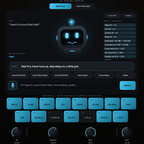
MIXI is TuneDrip's AI vocal mixing plugin. A small animated bot sits on the left of the plugin. You press the mic and say what you want into the same microphone you record with, or type it in a text box. MIXI answers in one sentence and shows every value it touched, before and after. Behind the bot is a complete chain in one plugin: gate, tuning, a second voice an octave or a fifth under or an octave above, EQ, two compressors, de-esser, grit, air, doubler, chorus, tempo-synced delay, an airy octave-up halo, reverb and a safety limiter.
A few details matter for real sessions:
-
It runs offline. The speech recognition and the assistant both run inside the plugin, on Mac and Windows. Nothing is sent anywhere, and there is no subscription to an online AI service.
-
It does not open your microphone. It listens to the audio your DAW already sends to the track, so the track must be armed. If it cannot hear you, it says so, and the text box always works.
-
Refining works in plain words. "Less reverb, more delay", "wider" or "make it deeper" adjust the chain, and UNDO takes back the last request.
-
Nothing is hidden. Each of the 15 modules keeps its own page in ADVANCED, so you can take over any setting by hand.
-
You can record through it. A LIVE mode brings the latency down to about 35 ms at 48 kHz while you track, then you switch it off to mix.
MIXI ships with 87 artist-style chains and 16 style chains as starting points. They reproduce the kind of tuning, saturation, delay and space heard on commercial records; they do not imitate anyone's voice, and no artist is affiliated with TuneDrip.
Not every "smart" vocal plugin needs to be AI
An assistant does not have to be a large language model to be useful. Booth is a full vocal chain of fourteen modules that you also drive with plain words: "remove the reverb and the delay, and make my voice wider", "warmer", "hard tune", "delay 1/8", "key of A minor". It understands requests with a built-in vocabulary that runs inside the plugin, works offline, lists every change before and after, and changes nothing if a sentence is outside its vocabulary. Booth is the right fit if you want precise, predictable commands rather than "sound like" requests, which it does not do.
Some of the most practical vocal tools use listening and detection rather than a chat window. They do one decision very well, which is often exactly what you need:
-
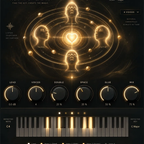
Key detection for tuning: VoxShift has Auto Key, which listens to your vocal, finds the key and locks to it in about two seconds, then loads one of 409 ready-made chains for singing, rap, doubles, ad-libs and SFX. Tune Live also offers AUTO KEY while you sing, with retune speed from an instant robotic sound to a transparent 200 ms.
-
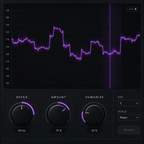
Automatic alignment: Trace pulls a double, a harmony or a choir part onto the timing of your lead, word by word, without changing its pitch or tone. Tightness decides how far it goes, so a stack can stay human.
-
Harshness that moves: Smooth listens to the spectrum continuously, finds narrow peaks such as sibilance or a boomy low-mid, and cuts them only while they last. A Vocal Sibilance preset turns it into a de-esser.
-
Harmonies in key: Harmony listens to your lead and builds diatonic harmonies in the key of the song, keeping the formants of the original singer.
Which type of AI vocal plugin do you need?
Start from the problem you have today:
-
"I don't know where to start with my vocal chain." An assistant-style plugin. Ask for a sound, listen, refine in plain words, then open the advanced pages when you are ready. MIXI is built for this.
-
"I know what I want, I just want to set it faster." A command-driven chain such as Booth, or a preset engine such as VoxShift.
-
"My vocal is out of key and I hate setting the scale." A tuning plugin with key detection: VoxShift or Tune Live.
-
"My doubles and harmonies never sit on the lead." An alignment tool such as Trace.
-
"My vocal sounds harsh on earbuds." A dynamic resonance tool such as Smooth.
-
"I want to sound like a different person." That is a voice model, not a mixing tool. Use it only with a voice you have the rights to.
What to check before you buy
-
Offline or online. A plugin that needs a server can stop working when the service changes. MIXI and Booth both run entirely inside the plugin.
-
Latency. Full chains need some look-ahead. Check the figure if you record through the plugin: MIXI has its LIVE mode, Booth reports about 61 ms at 48 kHz to your DAW, which compensates automatically on playback.
-
Control. An assistant should show what it changed and let you undo it. If you cannot see the settings, you cannot learn from them or fix them.
-
DAW and formats. TuneDrip plugins load as AU or VST3 on Mac and VST3 on Windows, so they run in FL Studio, Ableton Live, Logic Pro, Studio One, Cubase, Reaper and other hosts that load those formats.
-
License. TuneDrip plugins come with a lifetime license on three computers, with one license key per plugin sent by email after the order.
A simple workflow with an AI vocal mixing plugin
- Record your vocal dry, with healthy level and no clipping.
- Insert the assistant plugin on the vocal track and arm the track if you want to talk to it.
- Ask for a direction: a genre, a mood, or a starting chain.
- Refine with two or three short requests, such as "less reverb", "brighter" or "more delay on the ends of phrases".
- Open the advanced pages and check the tuning key and the compression, the two settings that matter most for a lead vocal.
- Use the same chain on the doubles, then pull the reverb back on them so the lead stays in front.
Black Friday: until December 1, TuneDrip plugins and plugin bundles take an extra 20% with code BLACKFRIDAY at checkout. Our Black Friday plugin guide lists what to pick by use.
The short version
An AI vocal plugin is only as useful as the problem it solves. For a finished vocal sound you can ask for in your own words, an assistant-style chain such as MIXI does the most work. For precise commands, Booth. For key, alignment and harshness, focused detection tools like VoxShift, Tune Live, Trace and Smooth. Browse all of them in our plugins collection.