
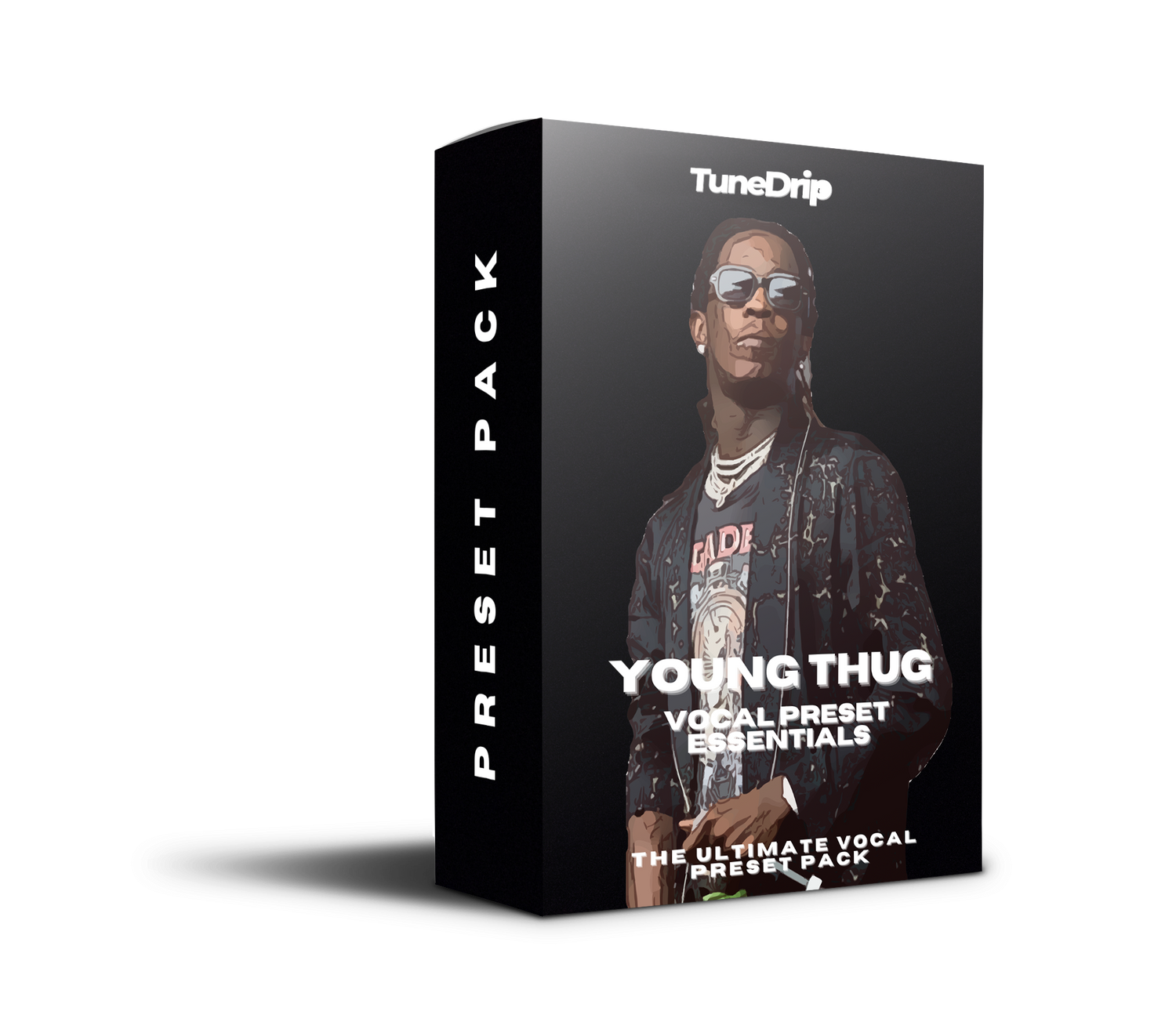
Young Thug might be the most technically interesting vocal case study in modern rap. He's a singer trapped in a rapper's world — using his voice as a pure instrument, bending phonetics in ways that technically shouldn't work but somehow create some of the most instantly recognizable sounds in hip-hop. The processing chain has to be as elastic as his delivery.
Thug's engineers (primarily at YSL's setup) have developed a chain over years that gives him maximum expressive range — handling everything from his guttural ad-libs to his delicate falsetto to his signature mid-range warble.
Why Young Thug's Vocals Are Technically Fascinating
The Auto-Tune is tracking something unusual. Thug's melodic approach doesn't follow traditional note patterns — he invents his own scales and intervals on the fly. The Auto-Tune has to track pitch that sometimes isn't landing on standard semitones, which creates those characteristic pitch artifacts where the correction is "working" but following something non-standard. Retune speed sits around 5-15ms — fast enough to create effect, slow enough to track his wild pitch movements.
His voice covers extreme registers. In a single verse, Thug might go from a deep chest voice to a high falsetto to a whispered run. The compression has to handle all of that — which is why his chain often uses multiple compressors with different ballistics, or a compressor with program-dependent attack and release (auto release is common).
Distortion and grit are part of the aesthetic. Thug's ad-libs especially have a raw, slightly overdriven quality. Light tube saturation on the ad-lib chain creates that character. The lead vocal is cleaner, but there's still subtle harmonic saturation — tape or analog-style — that adds warmth and aggression.
The reverb is big and dark. Thug's records have a cavernous, atmospheric quality. Medium-large room reverb, 1.5-2.2s decay, with the highs rolled off (unlike bright pop reverb). This creates that immersive, hypnotic feeling where the vocals swim in the production rather than sitting on top of it.
The Chain
- Auto-Tune: 5-15ms retune speed, Humanize at 10-20. Tracks his pitch but lets the artifacts become character.
- Compression: 4:1, medium attack (5ms), auto release. Handles the dynamic range of his extreme register shifts.
- EQ: High-pass at 120Hz, cut at 300-400Hz (-2dB), boost at 2-3kHz (+2dB), slight cut at 8kHz to tame harshness
- Saturation: Tape or tube, moderate (20-25% drive). Part of the character, not just warmth.
- De-esser: Moderate at 6-7kHz. Thug generates significant sibilance at high registers.
- Reverb: Large room or dark hall, 1.5-2.2s decay, highs rolled off at 5kHz, 25-30% mix
- Delay: Dotted 1/8, filtered heavily, 15-20% mix. Creates the hypnotic trailing effect.
The Presets
- Wyclef Jean Hypnotic — The core Thug sound: fast-ish Auto-Tune, dark reverb, saturation
- Slime Language Hard — Maximum aggression: more distortion, harder compression, faster Auto-Tune
- Chanel (Clean)** Melodic — The softer side: cleaner saturation, more musical Auto-Tune, wider reverb
- Best Friend Ad-Lib — Specifically designed for the ad-lib chain: more grit, shorter but present reverb
- Plus 6 variations across his different sonic modes
Compatible with FL Studio, Ableton, Logic Pro, and all major DAWs.
How to Record Young Thug-Style Vocals
Don't lock yourself to a melody. Thug's approach is stream of consciousness — he invents the melody as he goes, which means the performance has a spontaneous quality that rehearsed takes can't replicate. Record multiple loose takes and find the sections where your vocal invention is most interesting.
Separate your ad-lib chain from your lead. This is crucial for the Thug sound. The lead vocal gets the clean version of the chain (precise Auto-Tune, controlled saturation). The ad-libs get a different chain — more aggressive, more grit, more reverb, sometimes pitch-shifted down or up for texture. The contrast between lead and ad-libs is what creates that dense, layered quality.
Use your voice as an instrument. Thug makes sounds with his voice that aren't technically words — growls, vocal percussion, abstract melodic phrases. Don't be afraid to experiment with non-standard vocal sounds. The chain is designed to make them work in a finished record.
Record the ad-libs last, high energy. After you have the lead vocal locked, go back and record ad-libs with maximum energy — yells, calls, drops. These give the record life and energy that can't be programmed in.
Get the Young Thug Vocal Preset — engineered to capture his hypnotic, shape-shifting vocal style. See our vocal chain breakdown for more artist analysis.
FAQ
What Auto-Tune settings does Young Thug use?
Young Thug's Auto-Tune sits in the 5-15ms retune speed range — faster than the "invisible" range but not at the extreme 0-5ms of hard trap vocals. This creates noticeable pitch correction artifacts that actually become part of his melodic signature, especially when his voice bends between notes in ways that don't land on standard pitches.
How does Thug's vocal chain handle his extreme pitch range?
A combination of auto-release compression (which adapts to dynamics rather than using a fixed release time) and EQ that treats different frequency bands independently. The chain is designed to be elastic — it doesn't straitjacket his dynamics, it follows them.
Can I use the same preset for both rap and melodic sections?
Yes — the core "Wyclef Jean Hypnotic" preset is designed to handle both, which is Thug's primary mode (the blend of rap and melody in every bar). The "Slime Language Hard" variant is better when you're doing primarily straight rap flows.
What's the difference between Young Thug and Travis Scott's vocal sound?
Travis Scott uses harder pitch correction (0-5ms) and more atmospheric reverb, creating a more textural, washed-out effect. Young Thug's chain is more dynamic — faster pitch tracking (5-15ms), more saturation, darker reverb. The result is Thug sounds more energetically raw while Scott sounds more cinematic and dreamlike.
Ready to capture Young Thug's melodic trap vocal sound? Download the Young Thug Vocal Preset Essentials — preset variations for FL Studio, Logic Pro X, Ableton Live, GarageBand, and Pro Tools.



Leave a comment
This site is protected by hCaptcha and the hCaptcha Privacy Policy and Terms of Service apply.