
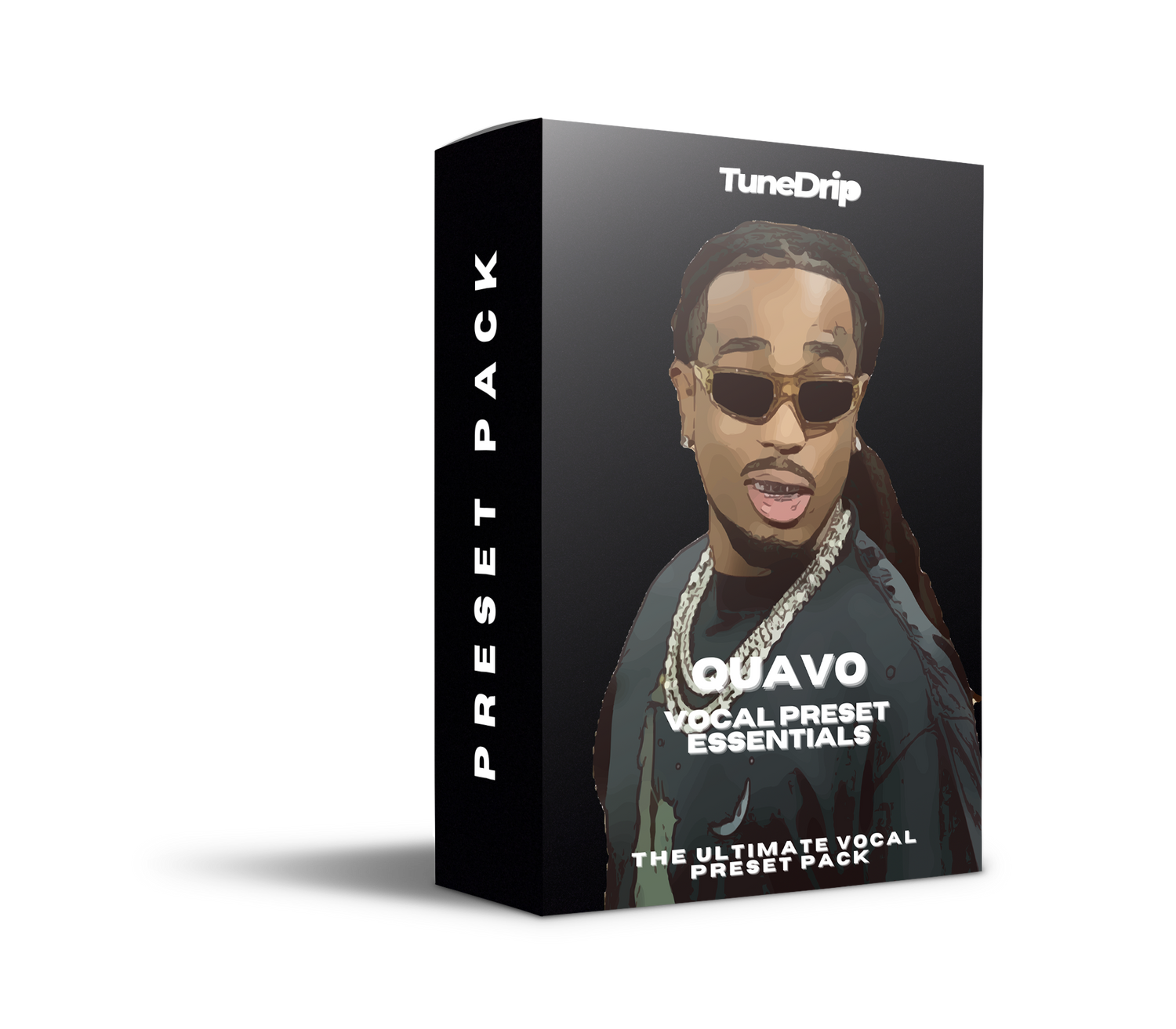
Quavo didn't invent the triplet flow, but he made it mainstream. And his vocal production is a key part of why it works so well — the Auto-Tune, the ad-lib layering, the way his voice sits in Migos' signature wall-of-sound production.
The Quavo Sound
Auto-Tune is melodic, not robotic. Quavo uses pitch correction around 8-15ms — fast enough to hear but slow enough to flow naturally with his triplet delivery. The Auto-Tune makes his simple melodies sound polished and catchy. On hooks like "Bad and Boujee," the correction is a bit tighter (5-8ms) for that extra shine.
The ad-lib game is foundational. Migos pioneered the modern ad-lib style — those "mama," "skrt," "brrr" sounds that fill every gap. Quavo's ad-libs get heavier processing than the main vocal: more Auto-Tune, more reverb, sometimes pitch-shifted. They're panned wide to create a stereo field around the center vocal.
Compression is punchy. 4:1, fast-ish attack (6-8ms), medium release. The triplet flow requires consistent volume across rapid syllables. The compressor keeps every syllable at the same level, which is essential for the flow to sound tight.
The Chain
- Auto-Tune: 8-15ms (hooks: 5-8ms)
- Compression: 4:1, fast attack, medium release
- EQ: High-pass 100Hz, cut 300Hz, presence 3-4kHz (+2.5dB)
- De-esser: Moderate at 6kHz
- Reverb: Short plate, 0.8s, 15% mix
- Delay: 1/4 note, filtered, 12% mix
Presets
- Bad and Boujee — The signature Migos hook sound
- Culture Flow — Triplet bars, punchy and tight
- Solo Quavo — More melodic, slightly less aggressive
- Plus 7 variations
Download the Quavo Vocal Preset Essentials


Leave a comment
This site is protected by hCaptcha and the hCaptcha Privacy Policy and Terms of Service apply.