
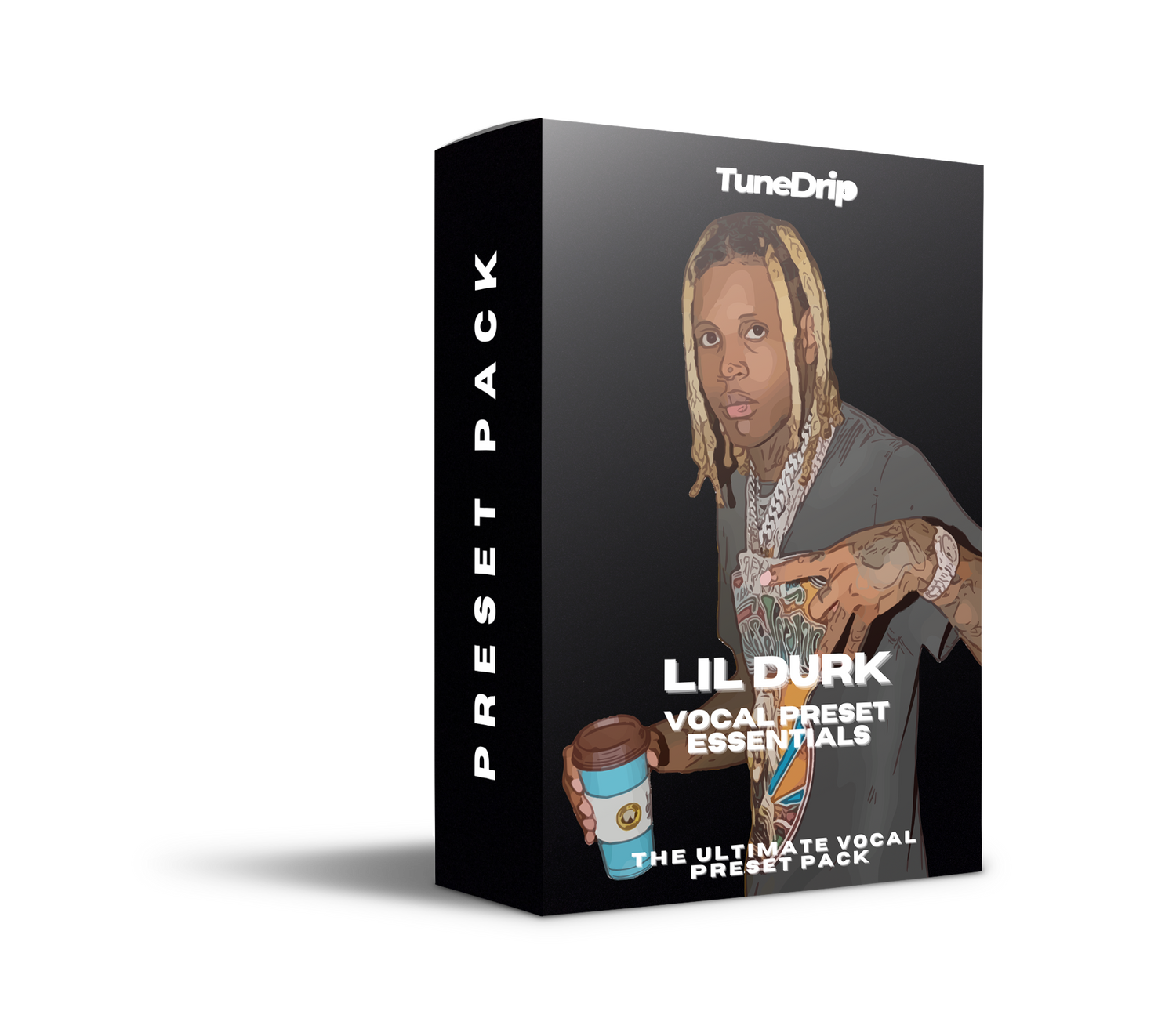
Lil Durk Vocal Preset: Chicago Drill Tone and Emotional Auto-Tune
Lil Durk occupies a unique space in rap: technically a drill artist, but emotionally closer to R&B than almost anyone else in the genre. His voice — raspy, melodic, built around Auto-Tune as a deliberate expressive tool rather than a corrective one — has evolved into one of the most distinctive and influential sounds in contemporary hip-hop. Artists like Rod Wave, NBA YoungBoy, and Polo G all show his fingerprints.
The TuneDrip Lil Durk preset captures the production techniques behind this sound: moderate-speed Auto-Tune that creates the classic melodic drift, compression that preserves the natural gravel and rasp in his voice, and a spatial setup that gives drill beats the depth they need without washing out the vocals.
What Makes Lil Durk's Vocal Chain Distinctive
Auto-Tune as Melody, Not Correction
Lil Durk's Auto-Tune setting is in the sweet spot between transparent and robotic — roughly 15–25ms retune speed, which creates audible pitch movement on sustained notes and melodic bends without the extreme "T-Pain effect" of very fast retune settings. The pitch correction is always "on" as an instrument in itself. When he holds a note, you hear the Auto-Tune walking it to pitch — not snapping. This glide is the signature character of the emotional drill sound he pioneered.
Rasp Preservation
Durk's voice has significant high-frequency texture — rasp and grain that lives in the 2–5 kHz range. Most vocal chains would smooth this out. His production team (primarily working with producers like Southside, OG Parker, and CashMoneyAP) preserves it deliberately. The EQ avoids cutting in that range and the compression attack time is slow enough (20–30ms) to let the gritty transients of his consonants through before the compressor clamps down.
The Chicago Drill Reverb Approach
Chicago drill vocal reverb is different from New York or UK drill. It's more ambient than atmospheric — a medium-length room or hall reverb (1.0–1.5s) that creates depth without the aggressive metallic character of UK drill. The reverb on Durk's vocals often has a slight warmth (rolled-off high end on the reverb return) that softens the density of the 808-heavy drill production underneath.
Minimal Processing Between the Elements
One thing consistent across Lil Durk's discography is that the chain is relatively short. There's no complex multi-band compression, no heavy saturation, no elaborate serial EQ stages. The processing is direct: pitch correction → EQ → compression → reverb. This simplicity keeps the vocal natural-feeling even under heavy Auto-Tune, because nothing else is transforming the source in unnatural ways.
The TuneDrip Lil Durk Preset — Full Chain
- High-pass filter: 100 Hz, 12 dB/oct — firm low cut, typical for rap vocals; removes boom and proximity effect
- Auto-Tune: Retune speed 20ms, humanize +10, minor key calibration standard — the defining element of the preset. The glide pitch movement is built into these settings
-
EQ (pre-compression):
- Low-mid cut at 200–250 Hz: -1.5 dB — cleans up muddiness without removing chest tone
- Rasp presence at 2.5 kHz: +2 dB (medium-wide Q) — the key frequency of his textural character
- Upper rasp at 4.5 kHz: +1.5 dB — preserves bite and edge in the vocal
- High-shelf at 10 kHz: +1 dB — slight air boost for intelligibility
- Compression: Attack 25ms, release 100ms, ratio 4:1, soft knee, -5 to -7 dB gain reduction — controls dynamics while letting rasp transients breathe
- Saturation: Minimal tape-style (1.5%) — barely audible, adds harmonic cohesion without changing character
- De-esser: 7–9 kHz, conservative threshold — only catches real sibilance; the rasp preservation means the de-esser is calibrated carefully to not over-suppress
-
EQ (post-compression):
- Notch at 800 Hz: -2 dB (narrow Q) — removes any boxy, nasal quality common in mid-range male rap vocals
- Presence at 5 kHz: +1.5 dB — final intelligibility boost post-compression
- Reverb Send 1 (Room): Pre-delay 10ms, decay 0.8s, high-pass at 200 Hz, warm low-pass at 10 kHz, mix 22% — the close, ambient depth
- Reverb Send 2 (Hall): Pre-delay 25ms, decay 1.3s, warm character, high-pass at 300 Hz, mix 20% — width and emotional distance
- Delay: Eighth-note, 8% mix, high-pass at 600 Hz, feedback at 1 repeat — presence delay typical of trap/drill productions
DAW Setup
FL Studio
This preset is heavily used in FL Studio — it's where most Chicago drill production happens. Load onto the vocal Mixer channel. Set up the two reverb sends as dedicated Mixer tracks. The Auto-Tune settings (20ms retune, +10 humanize) can be matched in Pitcher (FL's built-in) with smooth mode and partial tension — though Auto-Tune Pro or Auto-Tune Access will sound more authentic. In Pitcher: set "Speed" to 50%, "Tension" to 0.3.
Logic Pro X
Import the Channel Strip setting. Logic's Pitch Correction plugin at "None" humanization and 30% strength approximates the effect, though Auto-Tune via AU plugin is preferred. For reverb, use Chromaverb in "Room" mode (0.8s) for send 1 and Space Designer with a medium hall IR for send 2. The Vintage VCA compressor at ratio 4:1 matches the compression character.
Ableton Live
Load the FXChain preset. Auto-Tune as AU/VST handles pitch. The Glue Compressor at 4:1 is the compression backbone. Hybrid Reverb handles both sends — use the "Dark Room" algorithm for send 1 and a Hall IR at 55% size for send 2. Ableton's EQ Eight handles all EQ stages.
GarageBand
Apply the GarageBand patch. GarageBand's Pitch Correction at 50% strength with Preserve Formant off is the best built-in approximation of the 20ms Auto-Tune character. Use "Small Room" reverb as the primary send and "Medium Hall" as the depth send. GarageBand's stock compressor with "Opto" setting works for the main compression.
Style-Specific Production Tips
Working with the Auto-Tune Glide
The 20ms retune speed creates a glide on held notes — the characteristic "sliding to pitch" effect of emotional drill. To use this musically, coach the vocalist to hold notes slightly longer than natural (half a beat to a full beat on sustained melody notes) to let the Auto-Tune movement become audible. Short, spoken-style rap lines won't show the glide — it only emerges on melodic phrasing.
Layering for Depth
Durk's vocals are typically layered: a main vocal, a "ghost double" (identical performance slightly quieter, no pitch shift, panned center), and sometimes a whispered third layer. The ghost double adds density without the width of a hard double. Apply the same preset chain to all layers; adjust levels so the double is 6–8 dB below the main vocal. The whisper layer typically runs with just the room reverb, no Auto-Tune.
Mix Volume and Placement
Drill productions are 808 and hi-hat dominant. Place the vocal aggressively forward in the mix — louder than feels natural compared to the 808. The vocal should be clearly dominant; in drill, the vocal is the melody (there often isn't a melodic instrumental element), so it carries the harmonic content of the track. Target -14 to -15 LUFS on the vocal stem in a full drill mix.
Minor Key Compatibility
Most Lil Durk material is in a minor key or uses the minor pentatonic scale. The Auto-Tune key setting is critical — set to the key of the track in minor mode. Wrong key selection will cause Auto-Tune to pitch-correct to incorrect notes in the scale, creating dissonance instead of melody. If in doubt, use "Chromatic" mode (corrects to nearest semitone regardless of key) for safer results.
Frequently Asked Questions
Does this work for Rod Wave, NBA YoungBoy, or emotional rap styles?
Yes — all of these artists use similar vocal chains. Rod Wave is the closest to this preset: same Auto-Tune speed range, same emphasis on rasp preservation, similar reverb depth. NBA YoungBoy uses a slightly faster retune speed (15ms) and has less reverb. For Rod Wave specifically, increase the hall reverb mix to 25% for a bigger, more orchestral feel that matches his production context.
What's the difference between this and the Travis Scott or Yeat presets?
Travis Scott uses very fast Auto-Tune (8–12ms) for the extreme pitch-robot effect. Yeat's chain is even more aggressive with extreme pitch processing. Lil Durk is in the middle — emotional and melodic (20ms), not robotic. If you want the melodic drift to be clearly audible without becoming the sound-effect Auto-Tune of Travis Scott, Durk's settings are the target.
Can I use this on a drill instrumental in a different key?
Yes, but update the Auto-Tune key setting to match your instrumental key before recording. The preset defaults to A minor — change this to whatever key your beat is in for accurate pitch correction. The rest of the chain is key-independent.
Why does my vocal sound boxy even after applying the preset?
The 800 Hz notch in the post-compression EQ addresses this, but some voices have stronger resonances in that range. If boxiness persists, use a narrow bell cut (-2 to -3 dB) and sweep from 600 Hz to 1 kHz until you find the resonant frequency, then set a notch there. Male vocals typically resonate at 800–1,000 Hz; some record in spaces that add room resonance at similar frequencies.
The Emotional Drill Sound
Lil Durk proved that drill music and emotional vulnerability could coexist — that the same streets-hardened production framework that defined Chief Keef could carry melody, loss, and longing. His vocal chain is the technical expression of that idea. It's built to hold both weight and feeling at the same time.
This preset is for producers who want that balance.
Get the Lil Durk Vocal Preset at TuneDrip →
Ready to get this sound yourself? TuneDrip's Lil Durk Vocal Preset Essentials gives you the exact chain — just load it into your DAW and mix. If you're still building your preset library, browse the full trap sample packs collection for every DAW and every genre.


Leave a comment
This site is protected by hCaptcha and the hCaptcha Privacy Policy and Terms of Service apply.