
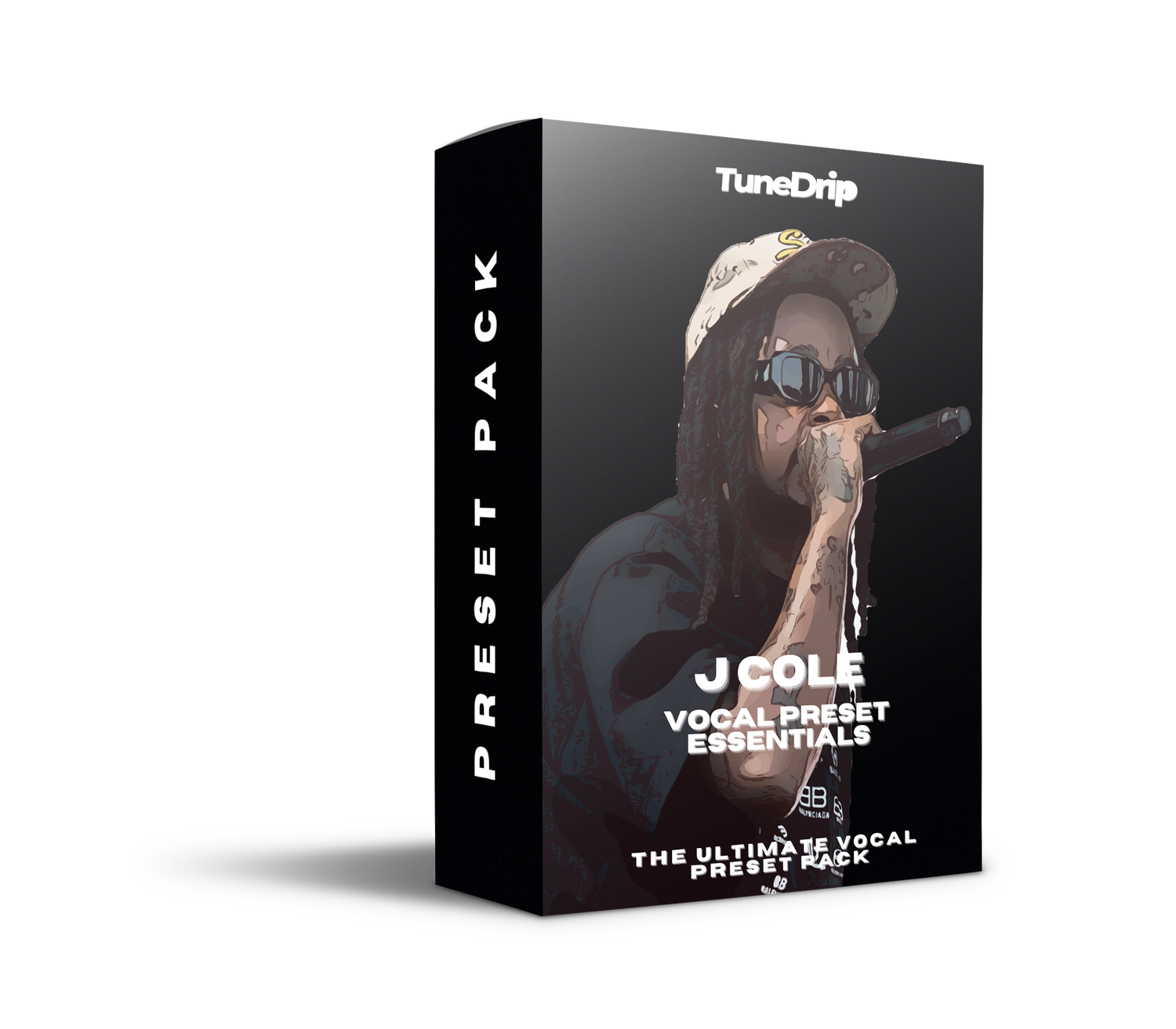
J. Cole is one of the few major rappers who almost never uses Auto-Tune, and his vocal production reflects that — it's built around making an unprocessed voice sound as good as possible. Clean, punchy, intelligible, with a warmth that makes you feel like he's in the room. No tricks. No effects. Just technique.
Cole's production approach (often self-produced at Dreamville studios) is about serving the lyric. Every word needs to land. The chain is designed to maximize clarity and impact without adding any artificial color.
Why J. Cole's Vocals Sound That Way
Zero pitch correction. Cole famously raps without Auto-Tune, and his pitch correction usage is minimal to none. His mic technique and breath control are developed enough that he doesn't need it. The naturalness of his delivery is a core part of his artistic identity — it's what separates him from contemporaries who rely on processing as an effect.
The compression is punchy but dynamic. Hip-hop vocals need to cut through 808s and heavy low-end, which means compression is essential. Cole's chain uses a two-stage approach: a fast optical-style compressor to catch transients, followed by a slower compressor to control the overall level. This creates punch without killing dynamics — you still hear the variance in his delivery, the emphasis he puts on certain words.
EQ is all about midrange clarity. Rap vocals fight for space in the 200-500Hz range where kick drums and 808s live. Cole's engineers cut aggressively in the low-mids (often -3 to -4dB at 250-300Hz) to clear that mud, then add presence in the 3-5kHz range where consonants and articulation live. The result: every syllable lands clearly even in a dense mix.
The reverb is minimal. Cole uses almost no reverb on his lead vocals — just a short room with a fast decay (0.3-0.6s) at 10-15% mix. This keeps the vocal bone dry and present. The size of the production comes from the beat, not artificial space on the vocal.
Parallel saturation for warmth. Instead of adding character with effects, Cole's chain often includes subtle parallel saturation — a warm tube or tape saturation blended at 15-20% with the clean signal. This adds harmonic richness without any obvious coloration.
The Chain
- Pitch correction: None, or 80-100ms retune speed (almost transparent, safety net only)
- Compressor 1 (fast): 4:1, fast attack (1-2ms), fast release (20-30ms). Catch transients.
- Compressor 2 (slow): 2:1, slow attack (20ms), auto release. Level control.
- EQ: High-pass at 100Hz, cut at 250-300Hz (-3dB), boost at 3-4kHz (+2-3dB for presence), cut 8kHz if harsh
- De-esser: Moderate. 6-7kHz, clean up the "s" sounds without killing articulation.
- Saturation (parallel): Tube or tape, 15-20% blend. Add warmth without obvious color.
- Reverb: Short room, 0.3-0.6s decay, 10-15% mix. Just enough to place the voice.
The Presets
- 2014 Forest Hills Rap — The core Cole sound: punchy, clear, warm, zero pitch correction
- KOD Introspective — Slightly more presence, for more lyric-heavy flows
- Off-Season Athletic — More compressed, punchier for fast flows and complex rhyme schemes
- Love Yourz Smooth — The warmer, more R&B-adjacent mode for melodic sections
- Plus 6 variations across different tempos and energy levels
Compatible with FL Studio, Ableton, Logic Pro, GarageBand, and all major DAWs.
How to Record J. Cole-Style Vocals
Your mic technique has to be on point. Without Auto-Tune to catch pitch and without heavy processing to mask problems, your recording quality matters more than with most styles. Use a quality large diaphragm condenser, treat your recording space, and dial in the gain properly (aim for -12 to -18 dBFS peaks).
Multiple passes, pick the best performance. Cole is known for recording many takes. The right delivery — the emphasis, the breath, the rhythm — matters more than any individual word being pitch-perfect. Record 5-10 takes and pick the one where the performance feels right.
Double your hooks. Cole layers doubles on choruses and hooks for width and energy. Record a tight double, hard-pan the two takes left/right, and the vocal section opens up considerably. Keep the differences natural — don't time-correct doubles aggressively.
Match your energy to the beat. Cole's delivery adapts to the tempo and feel of the instrumental. A boom bap Cole sounds different from a trap Cole. Let the production inform your vocal energy before applying any processing.
Get the J. Cole Vocal Preset — built for rappers who let the lyrics do the work. Visit our autotune settings guide for more artist breakdowns.
FAQ
Does J. Cole use Auto-Tune?
J. Cole famously does not use Auto-Tune. His vocal production relies on natural pitch, strong breath control, and technical recording quality rather than pitch correction as an effect. This is a deliberate artistic stance — he's referenced it in lyrics and interviews.
What's the key to getting that punchy rap vocal sound?
Two-stage compression: a fast compressor to control transients (fast attack, fast release) followed by a slower compressor for overall level control. Combined with mid-range clarity EQ (cutting around 250-300Hz, boosting presence at 3-4kHz), this creates the punch and intelligibility that defines the modern rap vocal sound.
Can I use this preset for melodic rap or hook sections?
Yes. The "Love Yourz Smooth" preset variant is specifically designed for the melodic, hook-oriented delivery Cole uses on ballads and R&B-influenced tracks. Slightly more reverb, warmer saturation, gentler compression.
What microphone does J. Cole use?
Cole has used various microphones across his career, with the Neumann U87 and Sony C800G being commonly cited. For getting the vocal character without the specific mic, focus on the processing chain — it's more important than the specific microphone model for home studio producers.



Leave a comment
This site is protected by hCaptcha and the hCaptcha Privacy Policy and Terms of Service apply.