
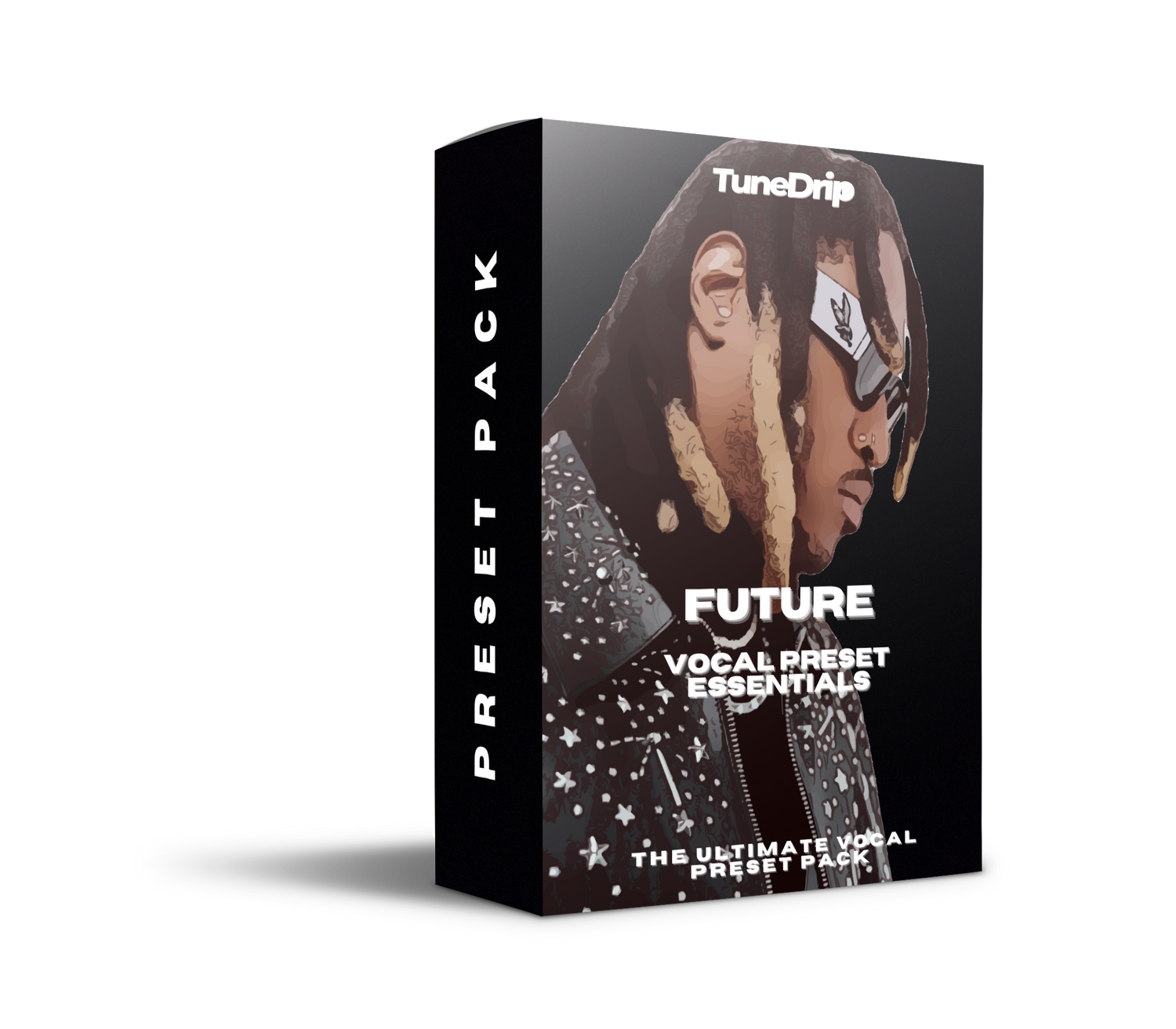
Future Vocal Preset — The Hendrix Chain Decoded
Future Hendrix created one of the most imitated vocal sounds in trap history — and one of the least understood. Most producers think it's just "heavy Auto-Tune with reverb." It's not. The Future vocal chain is a specific combination of heavy-set pitch correction, dark equalization, low-end warmth, and an atmospheric reverb treatment that makes vocals sound like they're being transmitted from a different dimension. Here's exactly how it works.
What Makes Future Sound Like Future
Future's vocal processing is built around intentional degradation — the goal isn't clarity, it's atmosphere. Where Drake wants warmth and The Weeknd wants cinematic space, Future wants his vocal to feel drugged, distant, and alien. The chain achieves this through:
- Slow-to-medium Auto-Tune retune speed (15–25ms in chromatic) creating gliding pitch artifacts on sustained notes
- Dark EQ profile — significantly reduced high-frequency content compared to most modern vocals
- Warm, almost muddy low-mids — unlike most hip-hop which scoops 200–400Hz, Future's chain preserves and even boosts this range
- Deep, dark reverb — long tails with heavy high-frequency damping that sound submerged
Full Future Vocal Chain
Step 1 — Minimal High-Pass
Unlike most vocal chains that high-pass aggressively at 80–100Hz, Future's chain keeps a gentle high-pass at 60Hz (12dB/octave slope). This preserves more low-end body in his voice — the chest resonance is part of the sound, not something to be cleaned out.
Step 2 — EQ: The Dark Profile
This is the most distinctive step. Apply:
- Bell boost at 200–300Hz: +3dB (wide Q) — adds warmth and muddiness deliberately. This is the "warm codeine" character
- Bell cut at 3–4kHz: -2dB — reduces intelligibility and presence (opposite of most vocal EQ)
- High-shelf cut at 10kHz: -3dB — darkens the top end significantly. No air boost here
The result: a vocal EQ that sounds counterintuitive compared to modern mixing practice. That's the point. Future's vocal is deliberately not optimized for clarity.
Step 3 — Auto-Tune (The Signature Step)
Future's pitch correction is the defining element. Settings:
- Retune speed: 15–25ms — fast enough to create the characteristic Auto-Tune "pull" on notes, but not robot-fast (not 0ms)
- Scale: Chromatic — not key-locked. This allows his pitch slides and ad-libs to have unpredictable gliding quality
- Humanize: 0% — no humanization, full correction consistency
- Input type: Alto/Tenor
The 15–25ms sweet spot is what creates the "Auto-Tune vocal" without full T-Pain robot effect. On long notes, you hear the pitch being "grabbed" — that's the signature Future glide. On faster syllables, it's near-transparent.
Step 4 — Compression
Optical-style compression (LA-2A style): slow attack (30ms), auto release, 4–6dB gain reduction. Future's delivery is relatively consistent in dynamics — he doesn't need aggressive VCA compression. The optical style adds gentle glue and slight color without changing the dynamic character.
On ad-libs and mumbled sections: increase gain reduction to 8–10dB to bring them up in level. Future's ad-libs ("Drip!", "Let's get it", mumbled phrases) often need heavier compression to sit consistently.
Step 5 — Saturation
A subtle tape-style saturation (5–8% drive) adds warmth and slightly rounds off transients. This works with the dark EQ profile to create the lo-fi warmth of Future's earlier work (Monster, 56 Nights). On newer Future (I NEVER LIKED YOU, MIXTAPE PLUTO), saturation is lighter — production has gotten cleaner even as the vocal character stayed consistent.
Step 6 — Reverb: The Dimensional Sound
Future's reverb is the most atmospheric of any major trap artist. Setup:
- Type: Large hall or chamber (NOT plate)
- Decay: 3–4 seconds
- Pre-delay: 20–30ms
- High-cut on reverb return: 3–4kHz — extremely dark reverb tail. Most reverbs high-cut at 8–10kHz; cutting at 3–4kHz creates the "submerged" quality
- Wet mix: 25–35% — more reverb in the mix than most contemporary rap
This dark reverb treatment is unique to Future. The 3–4kHz high-cut on the reverb tail is the single step most producers miss when trying to recreate his sound.
Step 7 — Delay
Quarter-note delay, also dark — apply the same high-cut (4–5kHz) to the delay return. 20% wet. This creates the thick, muddy echo that makes Future's hooks sound like they're echoing in a cave rather than a studio.
Key Differences by Era
Monster / 56 Nights Era (2014–2015): Maximum Darkness
Heaviest saturation, slowest Auto-Tune (25ms), most reverb. This is the definitive "Future sound" — raw, murky, atmospheric.
EVOL / Future (2016): Cleaner Trap
Slightly more present midrange. Reverb decay reduced to 2.5 seconds. Same Auto-Tune approach but production is cleaner so the vocal sits forward more.
I NEVER LIKED YOU / PLUTO × METRO BOOMIN (2022–2024): Modern Future
Less saturation, cleaner high-end, but Auto-Tune and dark reverb remain. The vocal character is consistent; the production context has modernized.
DAW Compatibility
| DAW | Auto-Tune | Compressor | Reverb |
|---|---|---|---|
| FL Studio | NewTone (15–25ms, chromatic) | Fruity Peak Controller | Fruity Reeverb 2 (high-cut enabled) |
| Logic Pro | Pitch Correction (fast-medium) | Vintage Optical | Space Designer (dark hall IR) |
| Ableton | Auto-Tune / Pitch Hack | Glue Compressor | Convolution Reverb (dark hall) |
| GarageBand | Pitch Correction (medium) | Studio Optical | Large Hall with low brightness |
| Pro Tools | Auto-Tune Pro (15ms, chromatic) | UAD LA-2A | Altiverb dark hall IR |
The Ad-Lib Chain
Future's ad-libs ("Drip!", "Yeah", mumbled phrases) have their own processing branch — heavier compression (up to 10dB GR), more reverb (40–50% wet), and even tighter Auto-Tune (10ms) for a more robotic quality that contrasts with the more human main vocal. On "Mask Off" and "Drip", this contrast between processed ad-libs and the warmer main vocal creates depth and texture.
Common Mistakes
- 0ms Auto-Tune ("full robot") — Future doesn't use 0ms. The glide at 15–25ms IS the sound
- Bright reverb — Adding a plate or bright reverb kills the atmosphere. Cut the reverb high shelf aggressively
- Scooping the low-mids — The warmth at 200–300Hz is intentional. Don't EQ it out
- Too little reverb in the mix — Future's reverb wet level is higher than most rap. Don't bury it; let it breathe
Get the Future Vocal Preset
The TuneDrip Future Vocal Preset delivers the complete Hendrix chain — dark EQ, chromatic Auto-Tune at 15–25ms, optical compression, dark saturation, and the signature submerged hall reverb with 3kHz high-cut. Era sub-presets included: Monster (darkest), EVOL (balanced), and Modern (cleanest). Available for FL Studio, Logic, Ableton, GarageBand, and Pro Tools.
Frequently Asked Questions
What Auto-Tune settings does Future use?
Future uses Auto-Tune at approximately 15–25ms retune speed, set to chromatic scale (not key-locked). This creates the characteristic pitch-gliding effect on sustained notes without full robot effect. He does NOT use 0ms — that's a common misconception.
Why does Future's voice sound so "dark" or "murky"?
The darkness comes from three sources: a high-shelf cut at 10kHz (reduces brightness), a low-mid boost at 200–300Hz (adds warmth), and a deeply dark reverb with high-cut at 3–4kHz on the return. Most vocal chains do the opposite of this.
Can I use Future's vocal chain for melodic trap?
Yes — the chain works well for melodic trap since the slow Auto-Tune is set up for melodic movement. For more melodic application, slow the retune speed to 30–40ms to allow more pitch expression, and reduce the reverb decay slightly for better definition on melodic phrases.
Does Future use pitch correction on his ad-libs?
Yes, with tighter settings (around 10ms) compared to his main vocal. His ad-libs sound slightly more robotic — this contrast between human main vocal and processed ad-libs is intentional and part of his layering technique.
Ready to get Future's exact sound in your productions? Download the Future Vocal Preset Essentials — available for FL Studio, Logic Pro X, Ableton Live, Pro Tools, GarageBand, and more.




Leave a comment
This site is protected by hCaptcha and the hCaptcha Privacy Policy and Terms of Service apply.