
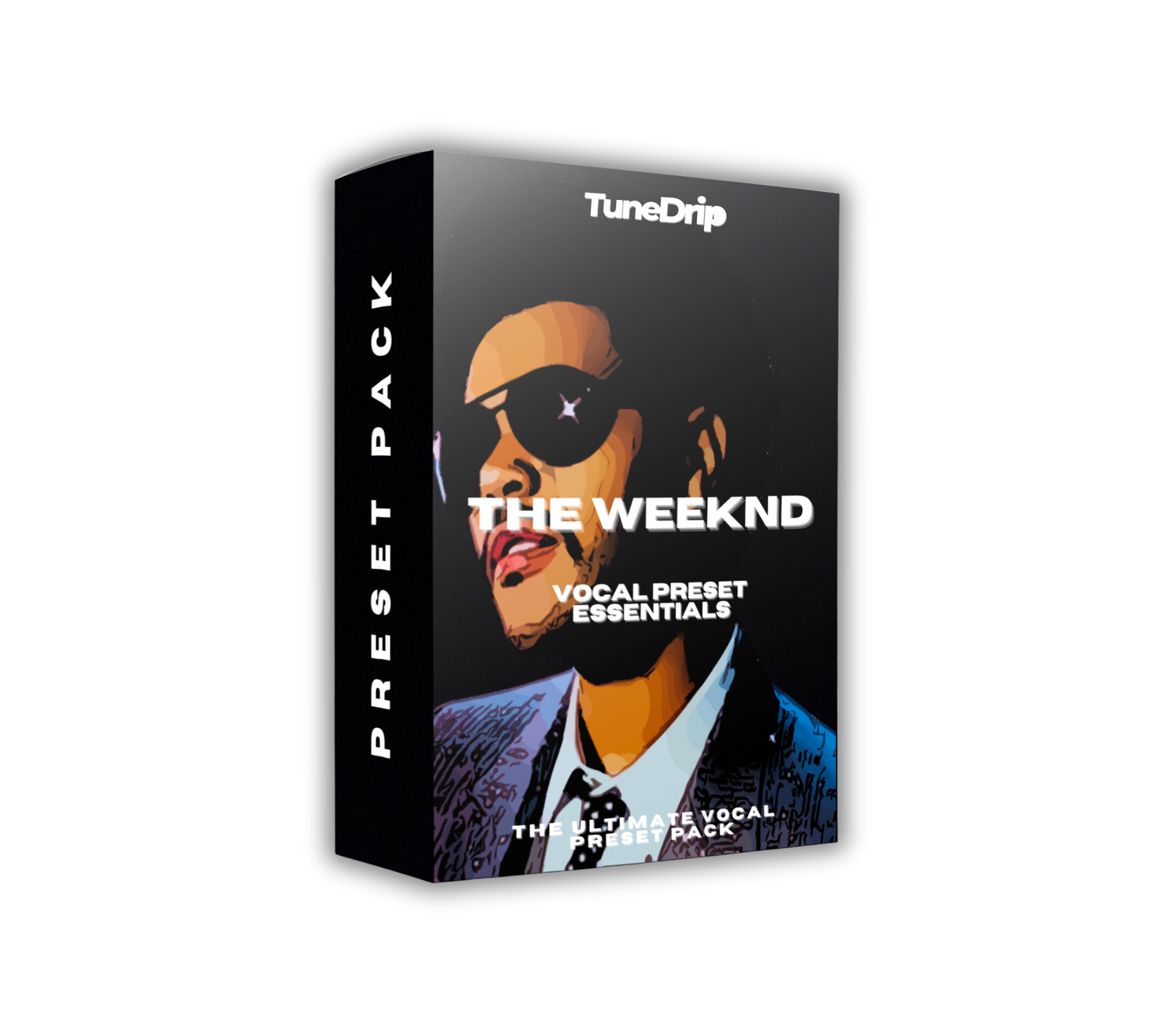
The Weeknd Vocal Preset — The Dark R&B Chain Decoded
The Weeknd's vocal sound is one of the most distinctive in modern music. From the raw, drugged-out falsetto of House of Balloons to the cinematic stadium power of Blinding Lights and the retro soul of Dawn FM, every era has a precise sonic identity. What ties them together: dark warmth, emotive falsetto control, and cinematic space. This guide breaks down The Weeknd's full vocal chain and shows you how to replicate it using the TuneDrip The Weeknd Vocal Preset.
The Weeknd Sound: What You're Actually Hearing
Abel's vocal production is defined by three core elements:
- Dark, mid-forward tone — The Weeknd's voice lives in the 500Hz–2kHz range. The low-end of his voice (chest resonance) is preserved deliberately — it's what makes his falsetto feel emotionally heavy rather than thin.
- Pitch correction used as texture — On early mixtapes, the pitch correction was stylistic and visible (almost like Auto-Tune as aesthetic). On After Hours and Dawn FM, it's polished but warm — retune speed between 25–40ms.
- Massive, cinematic reverb — The Weeknd uses some of the most spacious reverb in R&B. His vocals live in a large hall or cathedral space with long decay tails (3–5 seconds). This creates the emotional distance that makes his music feel like a film score.
The Weeknd Vocal Chain Breakdown
Step 1 — EQ (Pre-Compression)
High-pass filter at 80Hz — keep his low chest resonance. Unlike pop vocals that cut at 100–120Hz, The Weeknd's warmth depends on that 80–200Hz presence. Then: a gentle cut at 1–1.5kHz (-2dB, medium Q) to soften harshness in the midrange. His voice can sound nasal in this range without treatment.
Add a slight dip at 6kHz (-1.5dB) to take the edge off. His emotional delivery creates sibilant peaks that standard de-essers handle too aggressively — this EQ notch is more musical. Keep 8–10kHz presence intact — his falsetto breathes here.
Step 2 — Pitch Correction
The Weeknd's pitch correction evolves across his discography:
- House of Balloons / Thursday / Echoes of Silence: 50–80ms retune speed — intentionally loose, pitch drifts audibly for emotional effect
- Kiss Land / Beauty Behind the Madness: 25–35ms — tightened for commercial releases
- Starboy / After Hours / Dawn FM: 20–30ms — polished, nearly transparent on lead, more stylistic on adlibs
For most productions, target 25ms retune speed in the key of the song. His falsetto naturally sits between notes — pitch correction at this speed smooths without removing the vulnerability that makes his sound emotional.
Step 3 — Compression
The Weeknd's vocal dynamic range is wider than most commercial R&B — his delivery goes from breathy quiet to soaring screams. Use an optical-style compressor (LA-2A character) with:
- Attack: 20–30ms (slow enough to let the initial transient of consonants through)
- Release: Auto (program-dependent)
- Ratio: 3:1–4:1
- Gain reduction: 4–6dB
Follow with a second pass of parallel compression at 40–50% wet using a faster, more aggressive compressor. This combination — optical for transparency, VCA for density — is what gives his voice that "compressed but alive" quality on Blinding Lights.
Step 4 — EQ (Post-Compression)
Post-comp, add a warmth boost at 200–300Hz (+1.5dB, wide Q) — this restores the chest resonance that compression slightly dulls. Then a presence boost at 3–4kHz (+2dB, moderate Q) to push the vocal forward without harsh edge. This is the combination that lets his falsetto cut through dense 80s-inspired synth production on Dawn FM.
Step 5 — Reverb (The Key Element)
This is where The Weeknd's sound separates from every other R&B artist. His reverb is cinematic and dominant:
- Type: Large hall or cathedral
- Pre-delay: 40–60ms (creates a strong sense of separation before the tail)
- Decay: 3–5 seconds
- High-cut on reverb return: 4–5kHz (darkens the tail — this is why it sounds warm, not washy)
- Wet mix: 20–30% on lead vocal, 70–80% on a reverb send
The dark reverb tail (cut at 4–5kHz) is the single most important sonic decision. Bright reverb would make his voice sound pop and thin. Dark reverb makes it sound like a confession in an empty cathedral.
Step 6 — Delay and Width
Add a 1/8th note ping-pong delay at 15–20% wet, filtered (high-cut at 6kHz, low-cut at 300Hz). This creates the subtle stereo shimmer that you hear in his adlibs. For wider productions, add a short ambience reverb (0.4s decay, 100% wet) hard-panned on a harmony double — this is what creates the illusion of acoustic space in his more stripped productions.
DAW-Specific Settings
FL Studio
Fruity Parametric EQ 2: HPF at 80Hz, dip at 1.2kHz (-2dB, Q=2.0), dip at 6kHz (-1.5dB). Pitcher at 25ms retune, key of track. Fruity Compressor (optical mode): 3:1, 25ms attack, auto release. For reverb, use Fruity Reeverb 2 in "Hall" preset — set size to 85%, decay to 3.2s, high damp to 45%.
Logic Pro X
Channel EQ for both EQ stages. Pitch Correction at Speed 25. Compressor in Platinum Analog (optical character). For reverb: Chromaverb in "Cathedral" mode, decay 3.5s, high cut 5kHz on the tail, wet 25%. Add a Stereo Delay (1/8th sync, 18% wet, ping-pong).
Ableton Live
EQ Eight for both stages. Tuner + Pitch Corrector at moderate speed. Glue Compressor for glue. Reverb in "Large Hall" impulse at 3s decay — use the EQ on the reverb return to cut at 5kHz.
GarageBand
Channel EQ: HPF at 80Hz, subtract 400Hz boxiness, slight presence at 3kHz. Pitch Correction Speed 25. Compressor at "Keep or Compress." ChromaVerb at max room size, high damping dial at 60%, 3.2s reverb time.
Frequently Asked Questions
What vocal effects does The Weeknd use?
The Weeknd's signature effects are: (1) Auto-Tune at 20–40ms retune speed depending on the era, (2) optical compression for dynamic control, (3) large hall or cathedral reverb with a dark high-cut on the reverb tail, (4) ping-pong delay for spatial width. The TuneDrip preset replicates all four using stock plugins.
Does The Weeknd use heavy autotune?
It depends on the era. Early mixtapes (2011–2012) used more obvious, stylistic pitch correction. Post-Beauty Behind the Madness (2015+), the correction is tighter and more polished. On Dawn FM (2022), it's nearly transparent — the focus shifted to the 80s retro production, not the vocal effect.
What makes The Weeknd's reverb sound unique?
Two things: the long decay (3–5 seconds vs 1–2 seconds in most R&B) and the dark high-cut on the reverb return (4–5kHz). Most producers add reverb with full frequency response — it sounds washy and thin. Cutting the high end of the reverb tail makes it warm, dramatic, and cinematic.
Can I get The Weeknd's vocal sound with free plugins?
Yes. The TuneDrip The Weeknd Preset is built entirely from stock plugins in FL Studio, Logic Pro, Ableton, and GarageBand. No paid VSTs required. Every EQ band, compression setting, and reverb parameter is pre-configured.
What key does The Weeknd record in?
The Weeknd most frequently records in A minor, D minor, and E minor. His falsetto range sits comfortably in these keys. If you're recording with his vocal preset, setting your pitch correction to A minor or D minor will produce the most authentic result.
If you want to replicate this sound in your own sessions, TuneDrip's The Weeknd Vocal Preset Essentials pack has you covered — every setting dialed in, drag-drop into your DAW. Browse all vocal presets to find the right fit for your setup.




Leave a comment
This site is protected by hCaptcha and the hCaptcha Privacy Policy and Terms of Service apply.