
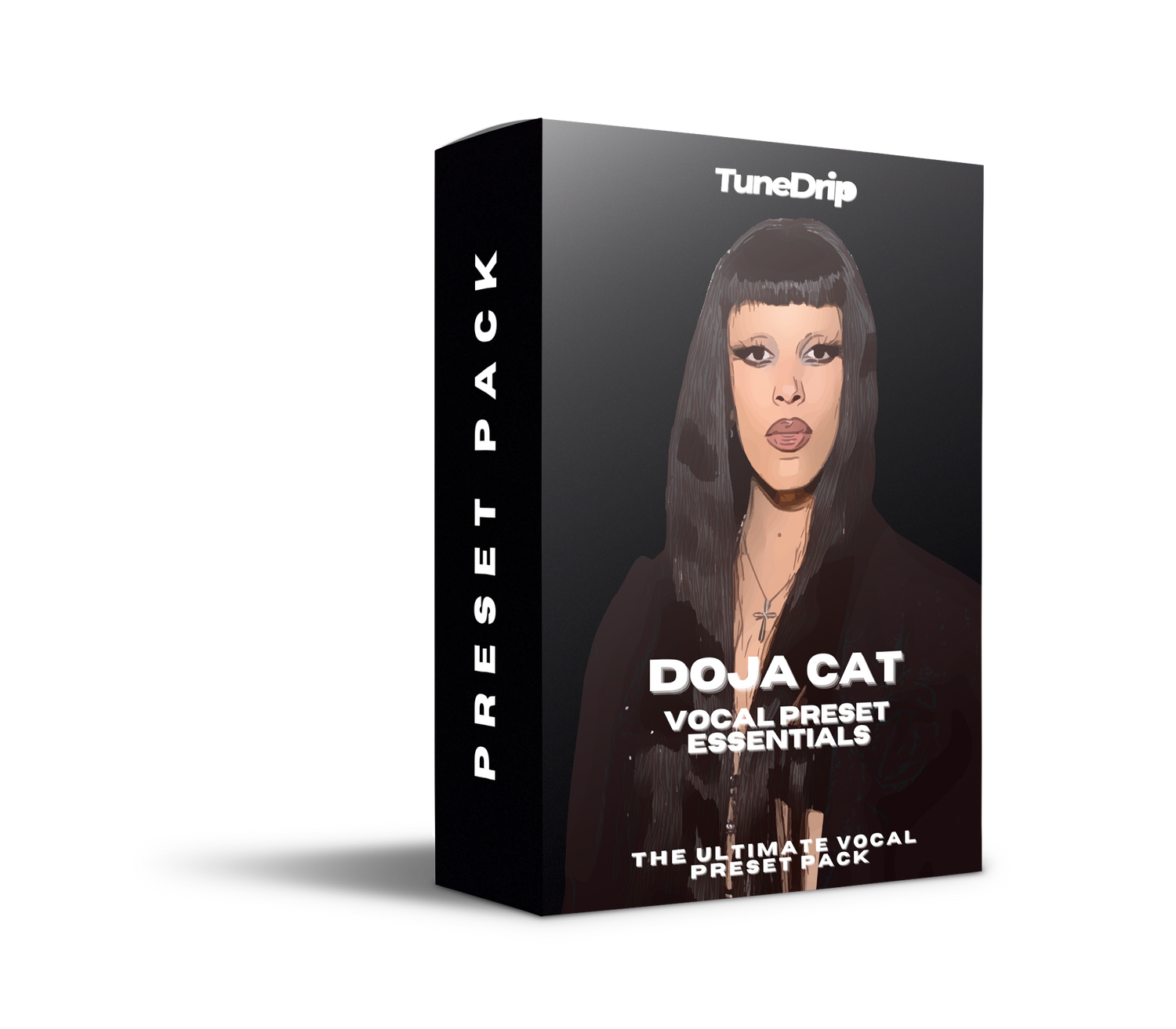
Doja Cat Vocal Preset — The Pop-Rap Vocal Chain Decoded
Doja Cat is one of the most sonically versatile artists in contemporary music. Her voice shifts effortlessly from silky R&B warmth on Say So, to sharp rap clarity on Streets, to stadium-ready pop power on Planet Her. Each era has a distinct vocal signature — but the processing philosophy stays consistent: clean, intimate, and radio-ready. This guide breaks down her full vocal chain and shows you how to replicate it using the TuneDrip Doja Cat Vocal Preset.
The Doja Cat Sound: What You're Actually Hearing
Her vocal production is built on three core pillars:
- Bright, airy upper midrange — Doja's voice sits forward in the 2–4kHz range with controlled presence, never harsh. The mix always lets the vocal breathe above the production.
- Pitch-transparent correction — She uses pitch correction at mid-speed (15–25ms retune), especially on pop songs. On rap verses it's tighter. The result: polished but human.
- Dense layering and harmonies — Doja almost always has stacked doubles and harmonies, processed differently to create width without cluttering the mono center.
The overall sound is modern commercial pop — it's optimized for streaming, earbuds, and car speakers simultaneously. Every frequency decision is intentional.
Doja Cat Vocal Chain Breakdown
Step 1 — EQ (Pre-Compression)
Start with a high-pass filter at 100Hz to remove low-end muddiness (her voice is naturally bright — you don't need those frequencies). Then: a slight dip at 400–500Hz (-2dB, medium Q) to remove boxiness that small rooms introduce. This is the signature move that gives her vocals that clean, "studio" quality even on home recordings.
The key addition: a gentle boost at 8–10kHz (+2–3dB, wide Q) for the characteristic pop "air" that makes her vocals sparkle on Spotify and Apple Music. This top-end presence is what makes vocals translate across streaming platforms.
Step 2 — Pitch Correction
For pop tracks like Say So and Need to Know: use Auto-Tune at 20–25ms retune speed in the key of the song. This smooths imperfections while preserving the natural slide between notes that makes her phrasing feel emotional. For faster rap sections (like her Praising U flow), tighten to 8–12ms — her rap delivery sits precisely on the grid.
Important: always tune your input to MIDI-correct pitch first before applying Auto-Tune. Doja's vocals are already well-pitched — the correction is polish, not rescue.
Step 3 — Compression
Doja's main vocal compression is transparent and clean. Use a VCA-style compressor (SSL-style) with:
- Attack: 10–15ms (fast enough to control transients on consonants)
- Release: Auto or 60ms
- Ratio: 3:1–4:1
- Gain reduction: 4–6dB average
Follow this with a limiter at -0.3dBFS to catch peaks and ensure the vocal never gets buried or clips in streaming normalization. This final clip is what gives her vocals that consistent, polished loudness on every platform.
Step 4 — EQ (Post-Compression)
Post-comp: add back the 3–4kHz presence (+1.5dB, broad Q). Compression slightly dulls this range — restoring it is what makes the vocal "sit forward" in a dense pop mix. This is the difference between a vocal that's loud vs one that's present. Also add a high-shelf boost at 14–16kHz (+1–2dB) for ultra-modern streaming air.
Step 5 — Reverb and Delay
Doja's reverb is kept tight and controlled — she's not a "swimming in reverb" artist. Her lead vocal uses:
- Short room reverb: 0.8–1.2 second decay, 15ms pre-delay, 10–15% wet
- Short slapback delay: 1/16th note, 15–20% wet, filtered (high-cut at 8kHz)
This minimal approach is intentional: her vocals are intimate. Drenching them in reverb would lose the connection. On epic sections (choruses of Planet Her), a broader hall reverb enters on the harmony layers — never the lead.
Step 6 — Harmonies and Doubles
This is where Doja's sound gets its width. She layers:
- A close double (same pitch, dry, panned slightly off-center)
- Stacked harmonies (3rds and 5ths above and below, processed with slightly more reverb and panned hard L/R)
- A pitched-down "ghost" layer (-1 octave, -24dB in the mix) that adds sub-presence without mudding the mix
The TuneDrip Doja Cat Preset includes a pre-configured harmony chain so you can add this signature layer with one click.
DAW-Specific Settings
FL Studio
Use Fruity Parametric EQ 2 for both pre and post EQ bands. Set Pitcher to Minor or Major (match your track key) at 70ms retune. For compression: Fruity Peak Controller sidechain into Fruity Peak or use the stock Fruity Compressor (grab-and-squash preset as starting point, back off ratio to 3:1).
Logic Pro X
Channel EQ for both EQ stages. Pitch Correction at Speed 30, Root Note matching track key. Use the Logic Compressor in VCA mode. For reverb: Chromaverb in "Room" mode, size 25%, wet 12%.
Ableton Live
EQ Eight for both stages — standard workflow. Auto-Tune (or Pitch Corrector from Ableton) at 30% speed. Glue Compressor for the VCA-style bus glue. Reverb at 0.8s decay, 12% wet.
GarageBand
Use Channel EQ plugin (same bands as above). Pitch Correction at "Speed" ~30. Compressor using the "Vocal Leveler" preset, then reduce ratio to 3:1. ChromaVerb in Room mode.
Frequently Asked Questions
What pitch correction does Doja Cat use?
Doja Cat primarily uses Auto-Tune (Antares) in real-time mode. On pop tracks she sets a medium retune speed (20–25ms). On rap sections she uses a faster retune (8–12ms) for tighter control. The TuneDrip preset replicates this with stock plugin equivalents for each DAW.
Does Doja Cat autotune her voice?
Yes — Doja uses pitch correction on nearly all her recordings, but at a natural setting that corrects without sounding robotic. Her vocal range and control are strong; the pitch correction adds commercial polish rather than compensating for poor pitch.
How do I get Doja Cat's airy pop vocal tone?
The airy quality comes from three sources: (1) a pre-EQ dip at 400Hz to remove boxiness, (2) a post-compression boost at 8–10kHz for streaming air, and (3) a high-shelf boost at 14kHz. Stack these with gentle VCA compression and you'll hit the signature. The TuneDrip Doja Cat Preset has all three baked in.
What reverb does Doja Cat use?
Her lead vocal uses a short room reverb (0.8–1.2s decay, 15ms pre-delay) at 10–15% wet. Her harmonies use a slightly larger hall at higher wet mix. The effect is intimate proximity on the lead with width from the layers — not washed-out reverb.
Can I use this preset without expensive plugins?
Yes. The TuneDrip Doja Cat Preset uses stock plugins only — no paid VSTs required. Every setting is replicated with built-in tools from FL Studio, Logic Pro, Ableton, and GarageBand.
If you want to replicate this sound in your own sessions, TuneDrip's Doja Cat Vocal Preset Essentials pack has you covered — every setting dialed in, drag-drop into your DAW. Browse all vocal presets to find the right fit for your setup.


Leave a comment
This site is protected by hCaptcha and the hCaptcha Privacy Policy and Terms of Service apply.