
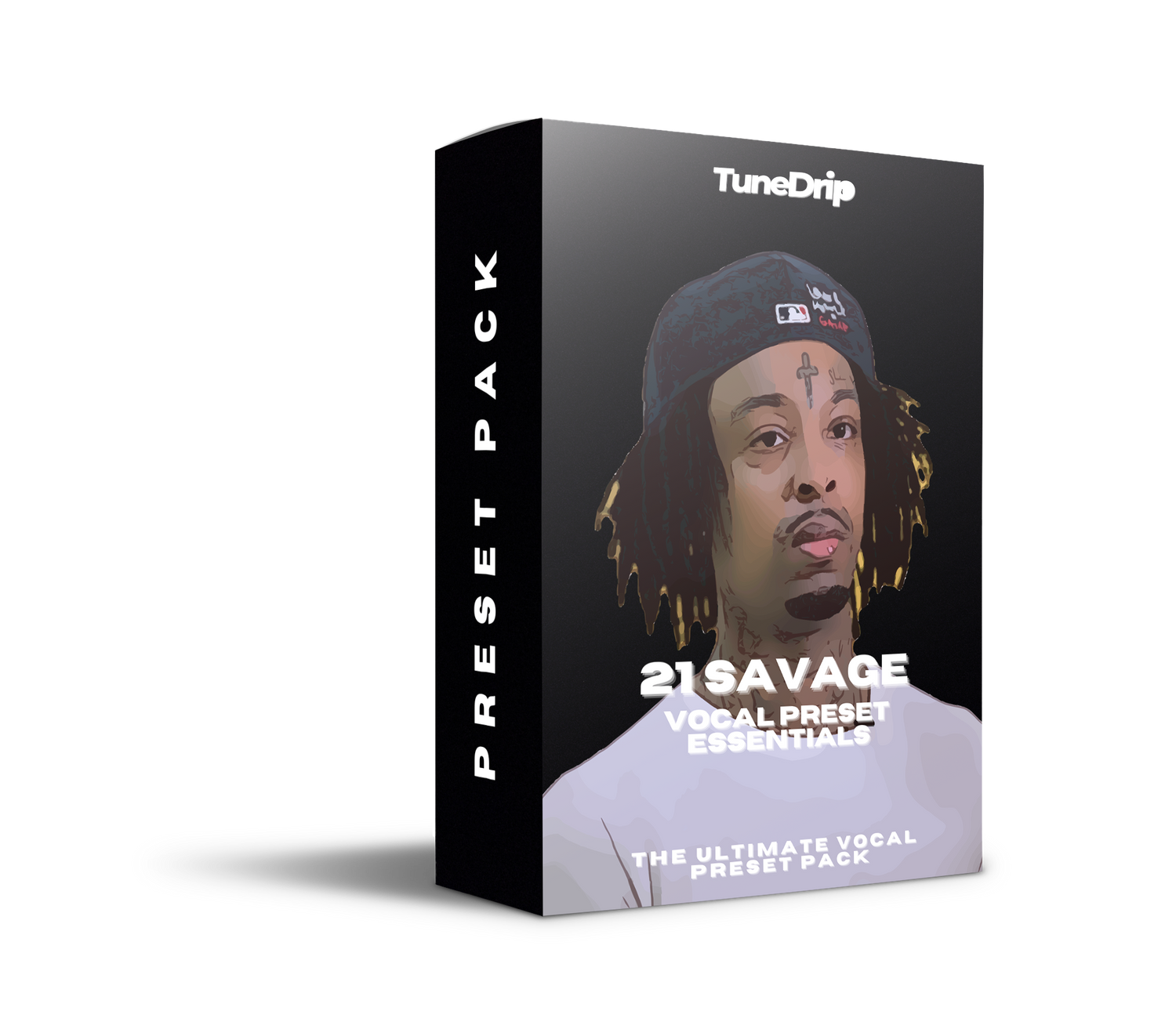
21 Savage Vocal Preset: Cold, Flat, Controlled
21 Savage's voice is one of the most distinctive in rap right now, and it's distinctive for a reason that surprises people when they try to recreate it: there's almost nothing on it. No heavy effects, no elaborate processing, no wash of reverb. The power in his delivery comes from restraint — from a chain that stays out of the way and lets the deadpan monotone do the work.
Getting that sound right isn't about adding things. It's about knowing exactly what to add — and what to leave out entirely.
The 21 Savage Aesthetic: Less Is More
Most trap vocal chains try to enhance the voice — boost the presence, add melodic pitch movement, create depth with reverb. 21's approach does the opposite. The processing is minimal and precise. The goal is a voice that sounds raw but polished, cold but present — sitting in the front of the mix with nowhere to hide.
That means any imperfections in the recording become part of the character rather than something to cover up. The chain assumes a confident, controlled delivery. If the performance isn't there, the minimal processing won't save it. That's also why it sounds so consistent — it doesn't rely on effects to carry the track.
EQ: Raw Midrange with Controlled Presence
The EQ on 21 Savage's vocals is built around midrange clarity. There's no heavy sculpting — the goal is to clean up without coloring.
High-pass at 100Hz to remove any low-end muddiness. A small notch around 300–400Hz cleans up any boxy resonance from the recording environment — a common issue in home studios. From there, a gentle presence boost at 2.5–3.5kHz adds cut without harshness.
The top end is relatively flat. There's no aggressive high-shelf boost. 21's voice already has enough clarity — pushing the high frequencies would make it sound over-processed, which is exactly what you don't want here.
Pitch Correction: Transparent, Not Musical
21 Savage doesn't use Auto-Tune as a musical effect. The pitch correction is there for tuning insurance, not to create a melodic effect. Retune speed: 35–45ms. That's slow enough to be invisible on his predominantly spoken/rap delivery while still catching any notes that drift.
On the rare melodic phrases he delivers — the occasional hook or sung line — the same settings work because the slower retune speed follows the natural movement rather than snapping it to pitch. Scale: chromatic.
Humanization: low, around 10–15%. The delivery is already naturally human — the pitch correction is just maintenance.
Compression: Front-of-Mix Consistency
The compression is where 21 Savage's mix presence actually comes from. A VCA-style compressor with moderate attack (15–20ms) and fast release (80–100ms) catches transients while maintaining punch. Ratio around 4:1–5:1.
The faster release time is key — it's what keeps the voice feeling aggressive and in-your-face even on lower-volume phrases. The compression doesn't smooth everything out; it controls the dynamic range while keeping the attack intact. That's the difference between a vocal that feels present and one that feels flat.
Follow this with a second stage of light limiting to catch any peaks before the reverb and delay chain.
Reverb: Minimal, Dark, Controlled
This is where most people over-process when trying to get a 21 Savage sound. The reverb on his vocals is deliberately restrained — it's there to give the voice a sense of being in a real space without washing it out.
Short room reverb: 0.6–1.0 second decay time. Pre-delay at 15–20ms. High frequency content in the reverb tail rolled off above 6kHz — you want a dark, tight tail, not a bright shimmer. Wet level around 10–15%.
That's it. No second reverb layer, no chorus, no modulation. The restraint is intentional.
Delay: Rhythm Without Clutter
A short slapback-style delay (1/16th note at 6–8% wet) adds just enough movement to prevent the vocal from sounding completely dry. It reinforces the rhythm of the delivery without creating an obvious echo effect. On a deadpan delivery style like 21's, this subtle rhythmic reinforcement is what keeps the voice feeling dynamic rather than static.
The "Her Loss" Era vs. "I Am > I Was" Era
I Am > I Was (2018): Slightly more presence in the 3kHz range, compression is punchier. This was the record that put him in the pop crossover lane — the vocal chain needed to work in a wider range of production contexts.
Savage Mode II (2020): The baseline cold trap sound — minimal reverb, flat EQ, VCA compression. Metro Boomin production with vocals that sit right in the pocket of the drum pattern.
Her Loss (2022): Working with Drake meant the chain needed to hold its own next to Drake's more heavily processed vocals. The presence region (2.5–3.5kHz) is slightly more emphasized, and the compression is marginally tighter.
DAW Compatibility
| DAW | Compatible | Notes |
|---|---|---|
| FL Studio 20+ | ✅ | Full preset compatibility |
| Logic Pro X/11 | ✅ | Native pitch correction works well for this style |
| Ableton Live 10/11/12 | ✅ | Load as audio effect rack |
| Pro Tools 2023+ | ✅ | Standard AAX plugin chain |
| GarageBand | ✅ | Simplified chain — works with built-in processing |
Building the Chain from Scratch
- Record clean: Good condenser mic, -6dBFS average, minimize room sound
- High-pass filter: 100Hz @ 18dB/oct
- Pitch correction: 35–45ms retune speed, chromatic, humanize 10–15%
- Notch filter: Narrow cut at 300–400Hz if boxy resonance exists
- EQ: +1.5dB at 2.5–3.5kHz (presence), flat high end
- VCA compression: 4:1–5:1 ratio, 15–20ms attack, 80–100ms release
- Limiter: -3dBFS ceiling to catch peaks
- Room reverb: 0.6–1.0s decay, 15ms pre-delay, 10–15% wet, roll off above 6kHz
- Slapback delay: 1/16th note, 6–8% wet
What Makes This Chain Difficult to Replicate
The honest answer is that 21 Savage's sound is difficult to replicate because it demands a very specific delivery. The minimal processing exposes everything — if the timing is off, if the pitch is wandering too much, if the delivery lacks confidence, the chain won't cover it up. It's not forgiving in the way that heavy reverb and melody-driven Auto-Tune can be.
The other common mistake is getting the reverb decay wrong. Too long (above 1.5 seconds) and the voice starts to feel distant rather than cold and present. Too dry and it sounds like a demo rather than a record. The 0.6–1.0 second window is narrow but it's where the sound lives.
Frequently Asked Questions
Does this preset work for melodic rap?
Not directly — the chain is optimized for trap/rap delivery with minimal melody. For melodic rap, you'd want to speed up the retune speed significantly and adjust the reverb for more depth. See the Gunna or Lil Uzi presets for melodic trap.
What microphone works best for this sound?
A large-diaphragm condenser in a treated room gives the cleanest starting point. 21 Savage's vocals are recorded in professional studios — the minimal processing means the source quality matters more than it would with a heavily effected chain.
Can I use this for a harder, more aggressive sound?
Yes — push the compression harder (5:1–6:1) and add slight saturation in the 2–4kHz range to add edge to the tone. That's closer to the Savage Mode II vibe.
Is the pitch correction really necessary if the vocalist sings in tune?
At 35–45ms it's essentially invisible even to trained ears. It's worth keeping in the chain as insurance — even small pitch inconsistencies become more obvious in a minimal chain where there's nothing to mask them.
Get the 21 Savage Vocal Preset
The TuneDrip 21 Savage Vocal Preset has all of this pre-configured — the EQ curve, the VCA compression ratio, the room reverb tail length with the correct high-frequency rolloff. Download, load, record.
The minimal approach is harder to get right than you'd think. It's easy to add too much reverb, compress too hard, or over-boost the presence region. The preset keeps you in the exact zone where 21's sound lives.
Want that dark, cold 21 Savage vocal sound in your trap records? Download the 21 Savage Vocal Preset Essentials — available for FL Studio, Logic Pro X, Ableton Live, Pro Tools, GarageBand, and more.




Leave a comment
This site is protected by hCaptcha and the hCaptcha Privacy Policy and Terms of Service apply.